The short version
A strong MVP is not the smallest feature list a team can ship. It is the least product work required to test a consequential assumption with an appropriate audience. Define the hypothesis and evidence first; features come second.
What is MVP development?
MVP development is the process of defining, designing, building, and releasing a focused product version to generate validated learning. Eric Ries defines an MVP around maximum learning with minimum effort, while Strategyzer stresses that the build exists to test critical business-model or value-proposition assumptions—not merely to produce software. Lean Startup Co. and Strategyzer both frame the concept around learning.
“Viable” still matters. The release must provide a coherent outcome to its intended early user and be safe enough for the context. A broken checkout, misleading result, or unusable workflow does not become a valid experiment just because it shipped quickly.
What should an MVP prove?
An MVP should reduce uncertainty that affects an investment decision. Write a falsifiable statement such as: “Independent hotel guests will complete a browser-based room-service order without calling reception.” Then decide what observation would support or weaken it.
| Risk | Question | Useful evidence |
|---|
| Problem | Is the pain real and important? | Observed workflow, interviews, repeated workaround |
| Value | Will the solution change behavior? | Activation, task completion, commitment, paid intent |
| Usability | Can users reach the outcome? | Completion rate, failure points, support requests |
| Feasibility | Can the critical mechanism work? | Technical spike, latency, accuracy, integration result |
| Viability | Can the model sustain delivery? | Acquisition signal, margin inputs, repeat use, retention |
MVP vs prototype vs proof of concept
Use the lightest artefact that can answer the current question. Atlassian distinguishes an MVP released for user feedback and market validation from a proof of concept used primarily to test feasibility. Its MVP overview also places testing and iteration at the centre of the process.
Proof of concept
Answers “can this critical mechanism work?” Audience is usually internal.
Prototype
Answers “does this interaction or concept make sense?” It may be non-functional.
MVP
Answers “will a defined audience use this outcome?” It is functional enough for real behavior.
The seven-stage MVP development journey
01
Name the decision
Write the decision this MVP must unlock: continue, change direction, or stop. A release without a decision is only a smaller product.
02
Find the riskiest assumption
Choose the belief most likely to invalidate the idea: the problem, audience, value, usability, feasibility, channel, or willingness to pay.
03
Define useful evidence
Decide what behavior would support or weaken that assumption before choosing features. Interviews, task completion, activation, repeat use, or paid intent can answer different questions.
04
Map one core journey
Describe the shortest end-to-end path in which a specific user reaches the promised outcome. Include the operational work needed behind the interface.
05
Set the MVP boundary
Include only what is necessary to deliver that journey safely, collect evidence, and operate the product. Record exclusions so they do not quietly return.
06
Design and build for learning
Prototype uncertain interactions, build the functional path, add analytics and feedback capture, then test the riskiest parts before release.
07
Launch, learn, decide
Release to a defined early-user group, review behavior and feedback together, and make the next product decision instead of automatically adding features.
How to scope an MVP without making it useless
Start with a vertical slice: one journey that crosses the interface, business rules, data, and operational handoff. A collection of polished but disconnected screens is not an MVP. For every proposed feature, ask three questions:
- Does it enable the core user outcome? If removing it breaks the journey, it is likely required.
- Does it protect users or operations? Authentication, privacy, error handling, and basic administration may be non-negotiable.
- Does it improve the evidence? Analytics, event capture, and feedback mechanisms can be more important than another visible feature.
Keep a written “not now” list with the reason each item is excluded. That protects the test from feature creep while preserving ideas for a later evidence-backed roadmap.
Should the MVP be web, mobile, no-code, or custom?
Platform follows the experiment. A responsive web app is often suitable when link or QR access matters and installation would add friction. Native or cross-platform mobile can be appropriate for device capabilities, offline behavior, notifications, or frequent repeat use. No-code can test straightforward workflows quickly; custom software becomes more valuable when differentiated logic, integrations, security, scale, or ownership matter.
If the web-versus-app choice is still open, use our web app vs mobile app decision guide before locking the scope.
MVP cost and timeline: estimate the system, not the label
“MVP” is not a complexity tier. A single workflow with regulated data, payments, real-time operations, or multiple external integrations can require more engineering than a broader-looking content product. The main cost and time drivers are product uncertainty, number of roles and journeys, platform count, design depth, integrations, data migration, security and compliance, and release infrastructure.
Agara commonly frames a focused MVP engagement around an 8–12 week delivery window once the core journey and exclusions are agreed. That is a planning range for our delivery model, not a universal industry benchmark. Discovery may recommend a smaller experiment before production code, or a longer plan where safety and integration risks demand it.
Measure the hypothesis, not vanity
Choose a small set of signals tied to the question. Downloads and page views can describe reach, but they rarely prove value on their own.
- • Activation: did the user reach the first meaningful outcome?
- • Task success: did they complete the core journey, and where did they fail?
- • Commitment: did they provide data, invite a colleague, request access, or pay?
- • Repeat behavior: did they return when the problem occurred again?
- • Qualitative evidence: why did they act, hesitate, abandon, or use a workaround?
Set the audience, observation period, events, and decision threshold before launch. Otherwise it is too easy to reinterpret weak results as success.
What happens after launch?
| Evidence | Decision | Next move |
|---|
| Strong and repeatable | Persevere | Improve reliability and expand carefully |
| Value exists, journey fails | Iterate | Repair the blocking interaction or operation |
| Wrong audience or value | Pivot | Change one major hypothesis and retest |
| Inconclusive | Run a sharper test | Improve sample, instrumentation, or hypothesis |
| Consistently weak | Stop | Protect further investment and document learning |
A first-party example: Selfserv
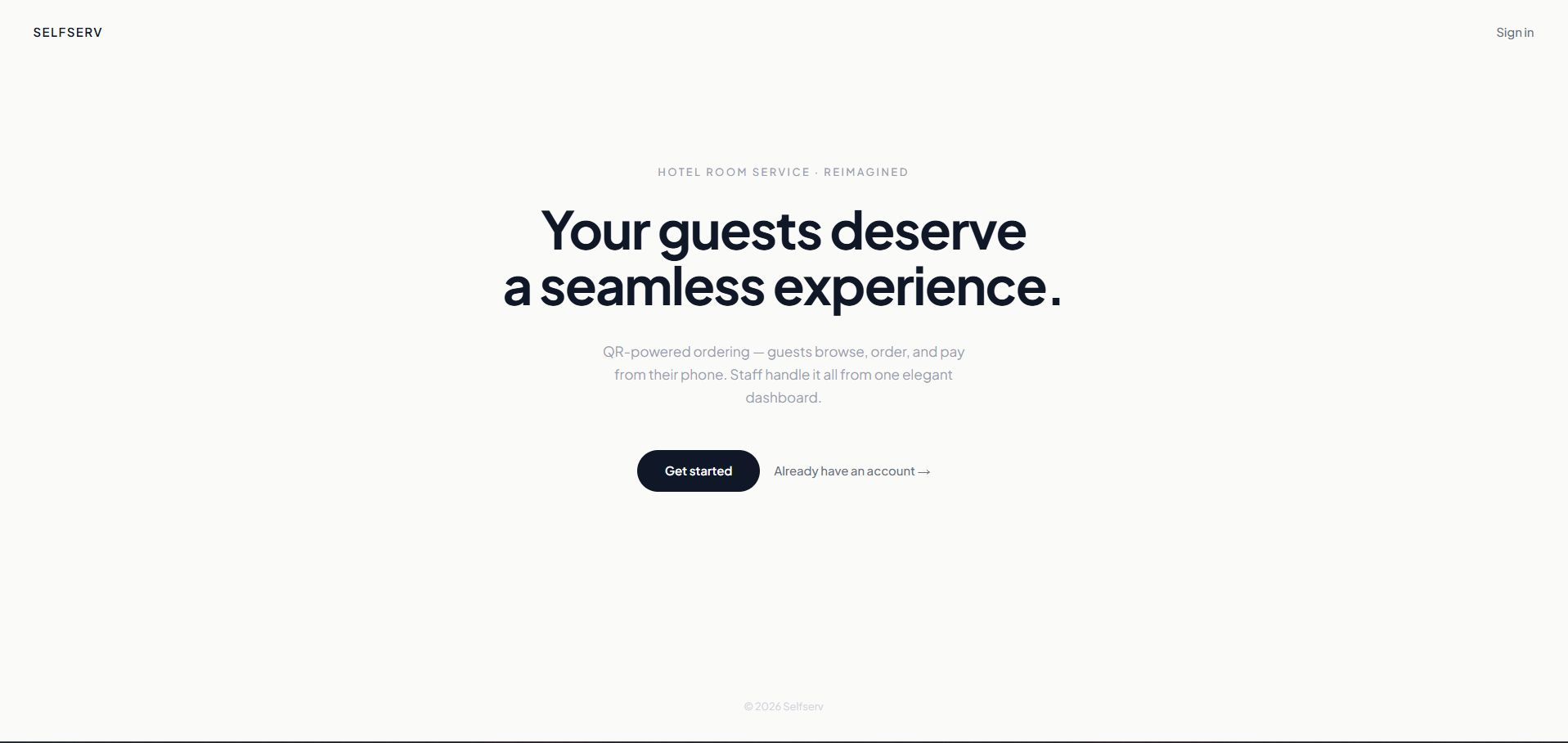
Selfserv is an internal Agara product built by Kresna Putra. Its MVP boundary connects one hospitality service loop: a guest enters from a hotel-specific QR context, browses an offering, builds an order, and moves through checkout while staff manage the operational side. The browser-first approach avoids requiring a guest app download.
The product demonstrates execution, not yet a published commercial outcome. We do not claim named-hotel deployment, active payment volume, adoption, conversion, or revenue. See the interface evidence and explicit limitations in the Selfserv MVP case study.
MVP planning checklist
- □ One product decision is written clearly.
- □ The riskiest assumption is explicit and falsifiable.
- □ A defined early-user group can be reached.
- □ Success and failure evidence is chosen before features.
- □ One end-to-end user outcome is mapped.
- □ Operational, privacy, security, and failure states are included.
- □ Exclusions are documented and accepted.
- □ Analytics and feedback capture are part of scope.
- □ A release and recruitment plan exists.
- □ The team agrees how it will persevere, iterate, pivot, or stop.
Turn the idea into a testable scope
Agara can help define the assumption, core journey, exclusions, product design, build, and release plan.
Frequently asked questions
What does MVP mean in software development?
MVP means Minimum Viable Product: the smallest functional product version that can deliver value to a defined user and produce evidence about a critical product assumption. It is a learning vehicle, not simply a cheap or unfinished application.
Is an MVP the same as a prototype or proof of concept?
No. A proof of concept primarily tests whether something is technically feasible. A prototype explores an experience or interaction, often without production functionality. An MVP is usable by its intended early audience and is released to learn from real behavior.
What features should an MVP include?
Include the features required for one complete user outcome, safe operation, and evidence collection. Exclude secondary personas, edge-case automation, broad integrations, and polish that do not materially affect the assumption being tested.
How long does MVP development take?
There is no universal duration because scope, integrations, compliance, platform, and team readiness vary. Agara commonly plans a focused MVP engagement around an 8–12 week delivery window after scope is agreed, but discovery can reveal that a smaller experiment should happen first.
How much does it cost to build an MVP?
MVP cost depends on product complexity, platform, integrations, data and security requirements, design depth, and how much uncertainty remains. A credible estimate needs a defined core journey and explicit exclusions; a generic price without those inputs is not a reliable quote.
Should an MVP be web or mobile?
Choose the platform that best reaches the target user in the moment the problem occurs. A responsive web product often reduces installation friction, while a mobile app can be justified by device capabilities, offline use, frequent engagement, or app-store distribution.
What happens after an MVP launch?
Compare the observed evidence with the hypothesis and threshold set before development. Then persevere, revise the audience or solution, run another experiment, scale the validated path, or stop. Shipping version two should be a decision, not a default.
Methodology note: This guide combines established Lean Startup and product-management principles with Agara's delivery perspective. Commercial ranges are identified as Agara planning context rather than universal benchmarks.